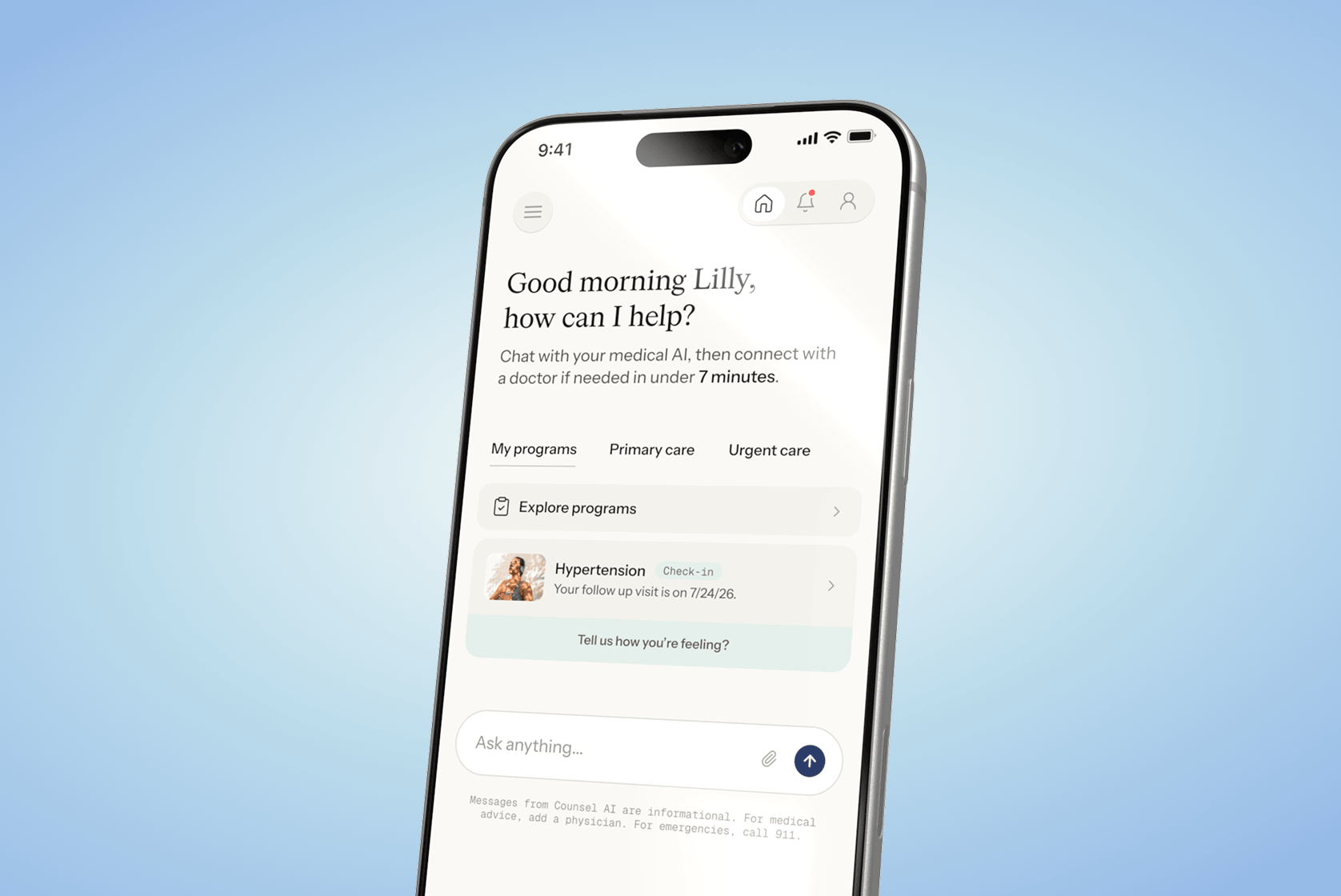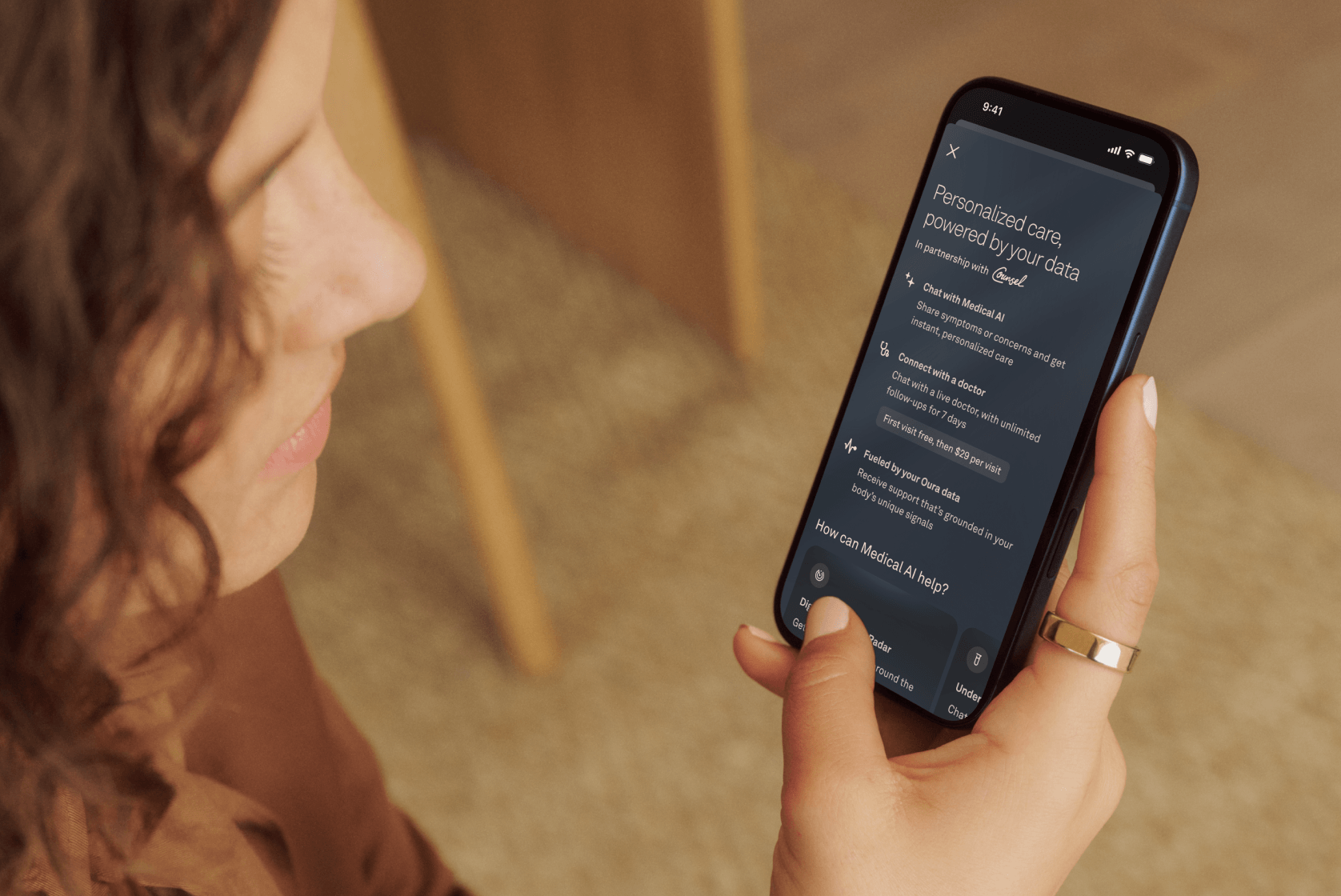

We’re excited to announce our partnership with ŌURA, maker of the world’s leading smart ring, to bring on-demand, physician-led care into the Oura App experience. Oura Members can now start with Medical AI from Counsel for clinical questions informed by their Oura data, and when needed, connect with Counsel’s board-certified physicians within minutes, right in the Oura App. The experience is simple. You can come into the Oura App with a broad range of health issues and needs—a headache, nausea, or PMOS—and begin chatting with our intelligent medical AI, which is designed to assess symptoms and think like a physician: reviewing your medical history, incorporating your biometric Oura data, asking thoughtful follow-up questions, identifying likely diagnoses, and helping guide next steps. When needed, the conversation can seamlessly escalate to a licensed Counsel physician within minutes, all within the same chat.
This is a return to how care used to be—in the context of your daily life, not apart from it. For most of human history, healthcare happened in the home. There were no clinics, hospitals, or healthcare "systems." If you became sick, a healer, herbalist, or physician came to you.
The idea that patients should travel to medical facilities is actually a relatively recent trend. Clinics rose to prominence in the early 20th century for two main reasons.
First, healthcare became increasingly dependent on advanced diagnostic equipment that had to be centralized in one place: lab testing, imaging, pathology, vital sign measurement, and more. It wasn't practical to carry this infrastructure from home to home.
Second, clinics dramatically improved physician efficiency. As doctors became more specialized and scarce, it became economically necessary for one physician to see dozens of patients a day in an office rather than traveling between homes.
Both of those assumptions are now beginning to change.
Wearable devices have transformed one of the foundations of medicine: the collection of health data. When members choose to share that data, it can help inform more personalized care grounded in what is happening in their daily lives, not just in a clinical setting. They've made it possible to collect high-fidelity biometric signals continuously, in the context of a person's daily life. In many cases, these measurements are more representative than what we capture in a clinic. For example, rather than measuring a patient's respiratory rate after they've just climbed two flights of stairs to an appointment they're running late to, we can see recorded O2 saturation levels continuously as they go about their day. Instead of measuring someone’s oxygen saturation in a sterile exam room, we will be able to capture it as they are walking their dog or settling in for bed. The infrastructure to collect data is no longer confined to a clinic; it now resides with the patient.
This creates a real opportunity to address the second challenge: physician efficiency. While clinics were undoubtedly more efficient than house calls, we find ourselves once again in a moment where healthcare is unsustainable and inconvenient. At Counsel, we believe the answer lies in messaging-based care. The mobile phone is already the fastest-growing care setting in the world, and we expect that more care will be delivered via messaging in the next decade than any other modality. Modern consumers are increasingly rejecting the idea that care requires a clinic visit or a video call. For many people, their care journey begins with a Google search or a ChatGPT query. At Counsel, we’ve built a model that embraces this preference.
Through Counsel's chat-based interface, patients can message with our medical AI and doctors to get immediate, thoughtful care, highly personalized to their data and preferences. On the backend, we've built a Clinician Cockpit—an "Iron Man suit" for our doctors—that enables asynchronous care at a scale and quality that couldn't exist before. Patients can chat with us on-demand over many days, checking-in as their symptoms evolve through the course of an illness. Users tell us this feels like having a doctor in the family; for many, it's a completely new way of receiving care.
With Oura, we'll have the chance to do something that has never been done at scale: combine high-quality biometric data with real physician actionability. When your Oura signals that an infection may be taking hold, Counsel can diagnose the underlying problem and proactively prescribe the right antiviral or antibiotic to help you feel better. When it detects a drop in blood oxygen O2 saturation, Counsel can use that data to differentiate a simple respiratory virus from an acute asthma exacerbation that may require an emergency room visit. Over time, we believe we can use Oura data to help manage your complex conditions like hypertension, hyperlipidemia, and diabetes—making personalized medication adjustments based on your ring data, at lower cost and with more convenience than traditional care.
Every care model reflects the technological realities of its era. For much of history, care happened in the home because it had to. Then medicine centralized around clinics because medical data could only be collected there. Now, for the first time in generations, modern technology allows us to bring care back to the patient: continuous, personalized, and available wherever they are. We're grateful to our partners at Oura for sharing this vision and excited for the impact we will have together.

Dr. Muthu Alagappan is a physician and former AI researcher, and the Founder and CEO of Counsel Health. He is pioneering an AI-enabled virtual care model that delivers immediate, personalized medical guidance by integrating advanced medical AI with in-house physicians. Previously, he served as Chief Medical Officer at Notable Health and as an Attending Physician at Massachusetts General Hospital and UCSF. He earned his BS and MD from Stanford University, where he researched healthcare and artificial intelligence.

Our content is created for informational purposes and should not replace professional medical care. For personalized guidance, talk to a licensed physician. Learn more about our editorial standards and review process.