Your employees are your most valuable asset, and supporting their health is an important part of caring for them. While employers have designed comprehensive benefits strategies to prioritize their well-being, up to 40% of benefits spending goes unused every year. Despite employers offering a sea of healthcare point solutions, employees still struggle to access the care they need.
AI triage solutions offer a new, modern paradigm, helping employees get faster, more reliable access to care while managing costs.
Triage is a concept that ensures people who need help most urgently can receive it as soon as possible. For example, if two people arrive at the hospital at the same time, one with a broken arm and the other with a stopped heart, triage ensures that the patient with the most pressing emergency will be seen first.
In this context, triage involves routing employees to the appropriate care setting based on several inputs, such as the leading medical concern and prior health history. An effective AI triage solution can help employees receive timely, cost-effective guidance
By using a responsible medical AI solution, such as Counsel, to manage employee care needs, employers can drive improved health outcomes and cost savings.
Here’s a simplified diagram of how a medical AI triage platform would deliver effective care for an employee within your population:
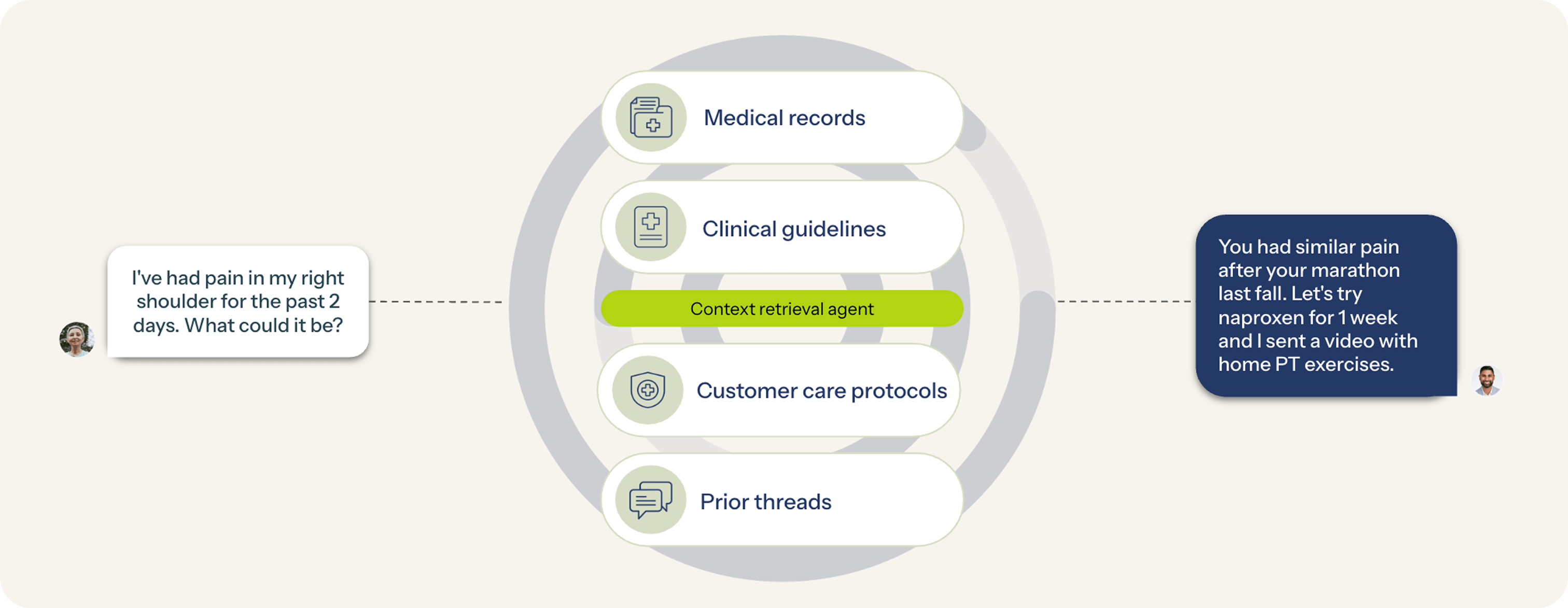
For example, if an employee reported a mild cough, the AI triage system might suggest home care tips or over-the-counter remedies. However, if a different employee showed signs of a severe or persistent cough, the AI could connect them with a licensed physician for further evaluation or lab tests.
In this way, the AI prevents non-urgent cases from unnecessary urgent care or ER visits, while ensuring that any at-risk cases receive timely in-person treatment.
Not leveraging an AI triage solution and relying on legacy modes of care, such as telehealth or nurse lines, can result in untapped value that could benefit your strategic initiatives.
An AI triage solution achieves two goals: It encourages employees to proactively take control of their health and expands access to care.
It’s this second point that has led to a frustrating healthcare experience for employees. Physician shortages are a major contributor to access challenges, with a projected shortage of 20,200 to 40,400 by 2036. These shortages have led to average wait times for primary care provider appointments of 31 days. This often discourages employees from seeking treatment, which may lead to complications and costly downstream care.
AI triage becomes a cost-effective way to unlock measurable health and business outcomes for any organization.
While sick employees can lead to direct costs from productivity losses, some costs are less apparent, namely, absenteeism and presenteeism. Delayed specialty care, for example, can cost U.S. employers $2,945 per employee per year, a cost that can be much higher when considering delayed care for other medical concerns.
With an AI triage solution in place, employers can rest assured that employees will have seamless access to safe, personalized care.
Having a medical AI triage solution is advantageous for your organization and your employees. With one in place, you can:
Importantly, an AI triage solution encourages employees to seek out the appropriate guidance for their symptoms.
Medical AI platforms that include triage capabilities, such as Counsel, go beyond assessing medical concerns. Instead of providing generic advice similar to that offered by search engines and consumer AI tools, these solutions offer care that is secure, continuous, and always available. Counsel, for instance, delivers a broad spectrum of care through a model that combines the speed of medical AI with in-house physicians who can be added to any conversations with the touch of a button.
By partnering with Counsel, employees have access to:
Although some people may view the appearance of AI in the medical field as a cause for concern, the technology can truly improve countless lives, as long as organizations partner with a solution that has built-in security protocols. The key lies in combining the speed and limitless memory of an AI chatbot with the safety, compassion, and clinical accuracy of a licensed human doctor.
Think of AI as an Iron Man suit for physicians, enabling them to care for more patients.
With a medical AI solution in place, triage becomes seamless, driving improved health outcomes and cost savings.
Counsel is the safe medical AI solution, HIPAA-compliant and SOC2 secure, to help advance your benefits strategy. With enterprise-grade AI security protocols, our care model effectively triages care, expanding access for your employee population through a convenient messaging-based platform.
Contact our team today to learn more about your options.

The Counsel Health editorial team is a multidisciplinary group of writers and editors dedicated to delivering clinically grounded, evidence-based health information. Their work is informed by real-world care delivery and guided by physician expertise, ensuring content is accurate, accessible, and trustworthy. By translating complex medical topics into clear, practical guidance, the team helps readers understand their health, explore care options, and make informed decisions in a rapidly evolving healthcare landscape.

Our content is created for informational purposes and should not replace professional medical care. For personalized guidance, talk to a licensed physician. Learn more about our editorial standards and review process.