
In the current U.S. healthcare system, members’ clinical histories are dispersed across multiple providers and facilities, often in formats that are difficult or slow to consolidate. This fragmentation limits a physician's clinical visibility, impacting care quality and creating gaps that cascade into higher costs, preventable complications, and operational inefficiencies for payer networks. Addressing these gaps is critical to deliver high-quality care at scale.
In 2024, 10% of patients reported having to repeat a test or procedure because earlier results were not available, highlighting the real cost of incomplete records and insufficient context in care decision‑making.
Achieving a complete, longitudinal view of a patient is critical during care delivery to reduce unnecessary utilization that impacts a payer’s network efficiency. Medical AI offers a modern solution to retrieving patient context, particularly when deployed following an agentic architecture and a dedicated Retrieval-Augmented Generation (RAG) pipeline.
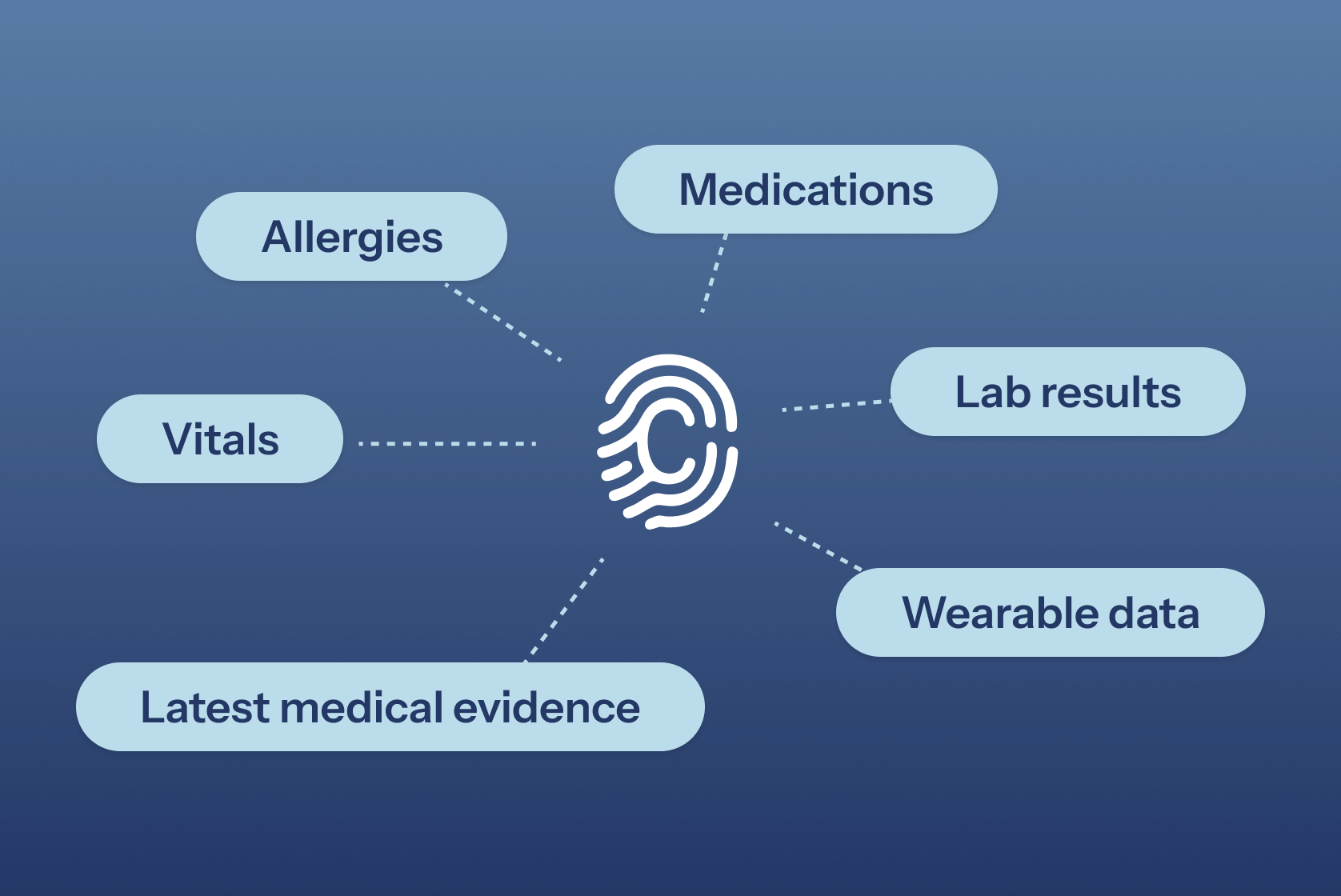
RAG represents a next‑generation AI paradigm that prioritizes context before generation. Unlike general-purpose LLMs that synthesize responses primarily from patterns in training data, RAG frameworks retrieve the most relevant data points, such as a member's medical history, prior treatments, lab results, latest medical evidence, and clinical protocols from payer organizations, before proposing actionable advice.
Solutions like Counsel, embed this RAG AI framework into care delivery, orchestrated by a context-retrieval agent part of a broader proprietary agentic architecture. This RAG pipeline dynamically pulls context that Counsel AI utilizes throughout every interaction.
This context-retrieval agent gathers clinical data from disparate sources, including medical history from Health Information Exchanges (HIEs) and EHRs, clinically validated external sources, and prior interactions. The relevant context informs the medical advice provided by Counsel AI and equips physicians with what they need to provide additional care, prescribe medications, and more.
Because it retrieves context first and then synthesizes it with medical reasoning, Counsel’s RAG AI is designed to reduce generic or incomplete outputs, effectively informing a series of agents that perform tasks, such as detecting emergencies and determining doctor escalations. Multiple, independent safeguard agents also run in parallel, ensuring every interaction meets clinical, legal, and payer-level standards for safety and compliance.
Counsel transforms a payer's front door into one where care actually happens. It embeds into any existing member portal or app, enabling complete customization to a health plan's clinical protocols, provider networks, COEs, and ecosystem of health solutions, ensuring maximum plan-alignment. As a result, Counsel can:
Partnering with an AI-enabled primary care solution that leverages a clinically-validated and optimized RAG AI framework delivers measurable strategic value:
Request a demo and discover how Counsel’s AI-enabled model leverages its agentic architecture and RAG pipeline to deliver high-quality longitudinal care aligned with payer strategies.

The Counsel Health editorial team is a multidisciplinary group of writers and editors dedicated to delivering clinically grounded, evidence-based health information. Their work is informed by real-world care delivery and guided by physician expertise, ensuring content is accurate, accessible, and trustworthy. By translating complex medical topics into clear, practical guidance, the team helps readers understand their health, explore care options, and make informed decisions in a rapidly evolving healthcare landscape.

Dr. Cían Hughes is a physician-scientist with over a decade of experience in health AI research. He began his career as an academic surgeon and, in 2015, joined Google DeepMind as its first Clinical Research Scientist, helping to found the DeepMind Health team. Prior to DeepMind, he was an NIHR Academic Clinical Fellow in Otolaryngology at University College London, working across the UCL Ear Institute and the Farr Institute while maintaining clinical practice.
Our content is created for informational purposes and should not replace professional medical care. For personalized guidance, talk to a licensed physician. Learn more about our editorial standards and review process.

.png)